Beyond Experimentation: Why Your SMB Needs an AI Second Brain
Small businesses are shifting from AI experimentation to full operational integration. Discover how an AI second brain helps you scale without increasing headcount.
Eric Rapaport, Founder
Quick Summary
Recent industry data shows that small and medium-sized businesses are rapidly moving from AI pilots to full-scale operational deployment. While adoption rates have surged, many owners struggle to bridge the gap between using individual tools and achieving meaningful business impact. An AI second brain acts as a centralized intelligence layer that connects your data and workflows to drive efficiency. This article explores how this strategic approach allows SMBs to scale revenue while keeping operations lean.
Beyond Experimentation: Why Your SMB Needs an AI Second Brain
For years, small business owners viewed artificial intelligence as a novelty or a series of disconnected experiments. That era is over. As we move through 2026, the conversation has shifted from "should we use AI" to "how do we make AI the foundation of our growth." Recent reports indicate that AI adoption among small businesses has reached record highs, yet many owners still feel stuck in a cycle of testing tools without seeing a clear return on investment.
The Gap Between Adoption and Impact
It is easy to sign up for a dozen different AI subscriptions. You might use one tool for drafting emails, another for social media graphics, and a third for financial analysis. While these tools are helpful, they often create new silos. Your data remains scattered, and your team spends more time switching between tabs than actually executing strategy. This is the primary reason many businesses fail to see the promised productivity gains. High adoption does not automatically equal high impact if your systems do not talk to each other.
What is an AI Second Brain?
An AI second brain is not just another software subscription. It is a centralized architecture that captures, organizes, and synthesizes your business knowledge. Think of it as a digital partner that remembers your processes, understands your customer history, and automates routine decision-making. By feeding your specific business data into a unified system, you move away from generic AI outputs and toward intelligence that is tailored to your unique operations.
Scaling Without the Headcount
One of the most significant trends in 2026 is the decoupling of revenue growth from headcount. Historically, growing a business meant hiring more people to handle the increased workload. Today, an AI second brain allows you to scale your output without necessarily scaling your payroll. By automating tasks like sales quoting, invoice reminders, and customer service inquiries, you free up your human team to focus on high-value creative and strategic work. This is how small businesses compete with larger enterprises that have massive administrative departments.
Building Your Strategy
To move from experimentation to a true second brain, you must prioritize data integrity. AI is only as good as the information it processes. Start by auditing your current workflows. Identify the repetitive tasks that drain your team's energy every week. Once you have identified these bottlenecks, look for ways to integrate your core business data into a single AI-driven environment.
Focus on these three pillars:
- Centralization: Move your documentation and customer data into a format that AI can easily index and retrieve.
- Automation: Use your second brain to trigger actions based on specific events, such as following up on a lead or flagging an overdue invoice.
- Synthesis: Use AI to analyze your performance data, allowing you to make decisions based on trends rather than gut feelings.
The Future of SMB Operations
As the market becomes more competitive, the businesses that win will be those that can adapt the fastest. An AI second brain provides the agility needed to pivot when market conditions change. It turns your business into a learning organization that gets smarter with every interaction. By investing in this infrastructure now, you are not just buying a tool. You are building a competitive advantage that will serve your business for years to come.
Rather have this built for you? That's what we do.
Leave a Comment
Comments (0)
Related Articles

Small businesses are moving past basic AI experimentation toward strategic adoption of intelligent systems. An AI second brain offers a way to centralize your company knowledge and automate complex workflows.
Small business owners are increasingly turning to AI to reclaim time and drive growth. Building an AI second brain is the next step to turning scattered information into a competitive advantage.
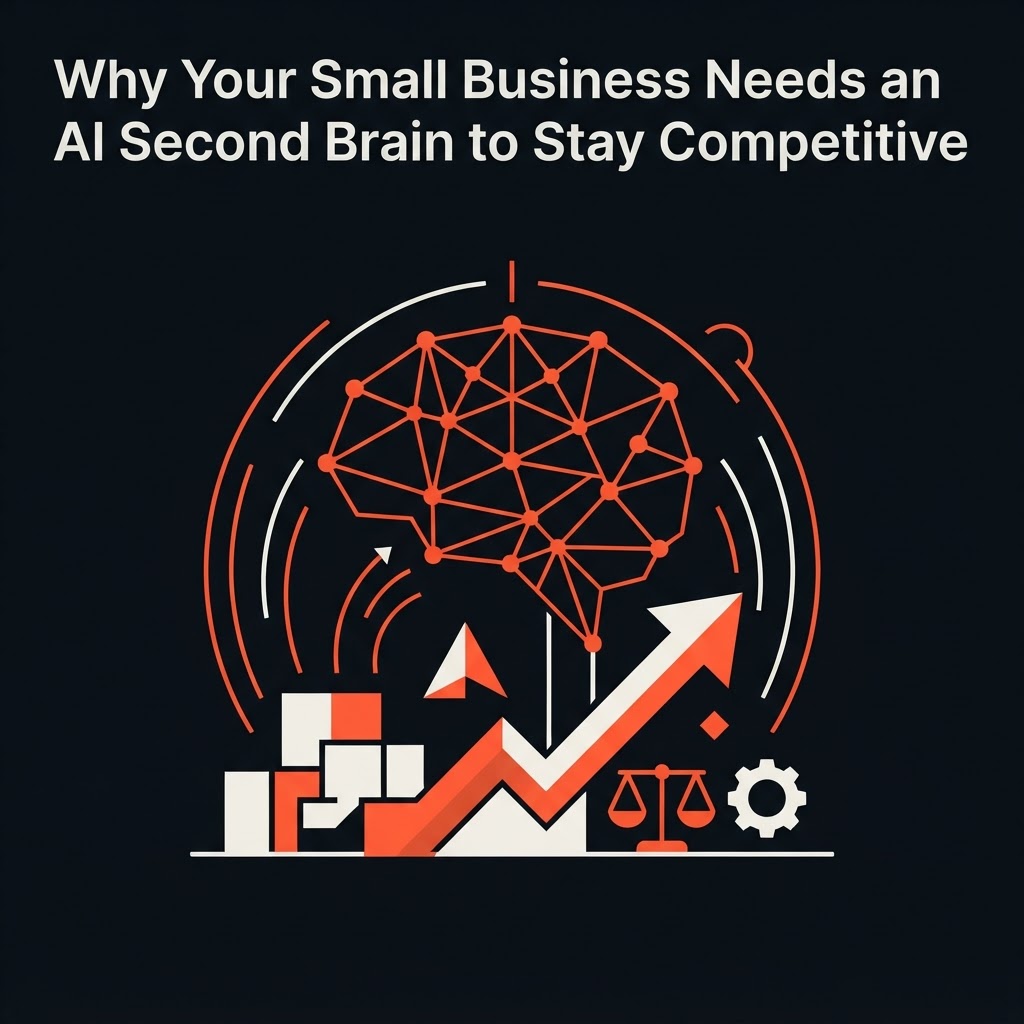
Small business owners are racing to adopt AI, but many struggle with fragmented data and tool sprawl. An AI second brain solves this by centralizing your knowledge into a single, actionable system.