Why Small Businesses Are Trading Chatbots for Autonomous AI Agents
The era of simple AI chatbots is ending as autonomous agents take over daily business operations. Discover how these digital coworkers are helping small teams do more with less.
Eric Rapaport, Founder
Quick Summary
Recent developments from Nvidia and SpaceXAI highlight a major shift toward agentic AI that can execute multi-step tasks autonomously. For small businesses, this means moving away from simple prompt-response tools toward systems that manage entire workflows like lead qualification or invoice processing. Success with these agents requires a central knowledge base, often called an AI second brain, to ensure accuracy and security.
Why Small Businesses Are Trading Chatbots for Autonomous AI Agents
The week of August 12, 2026, marked a clear turning point for small businesses using artificial intelligence. The industry is moving away from the era of the chatbot and into the era of the agent. While early AI tools focused on answering questions or drafting short emails, the new generation of autonomous agents is designed to actually finish the work.
Major announcements this week from Nvidia and SpaceXAI show that the technology has finally caught up with the ambition of small business owners. Nvidia released Nemotron 3.5 Lightning, a model specifically optimized for using external tools and software. Meanwhile, SpaceXAI launched its Grok Bot agents, which are marketed as always-on digital coworkers. These updates represent a shift from reactive technology to proactive systems that can manage complex tasks without constant human supervision.
The Shift from Chatbots to Agents
For the past two years, most small business owners have used AI as a faster way to search the web or write a first draft. This is the chatbot model. You give a prompt, and the AI gives a response. However, this still requires a human to take the output and apply it to their business systems.
An autonomous agent operates differently. Instead of waiting for a prompt, you give it a goal. For example, a business owner might tell an agent to identify all overdue invoices, verify the customer contact details, and send a polite follow-up email with a payment link. The agent handles the multi-step reasoning, accesses the necessary software, and executes the actions.
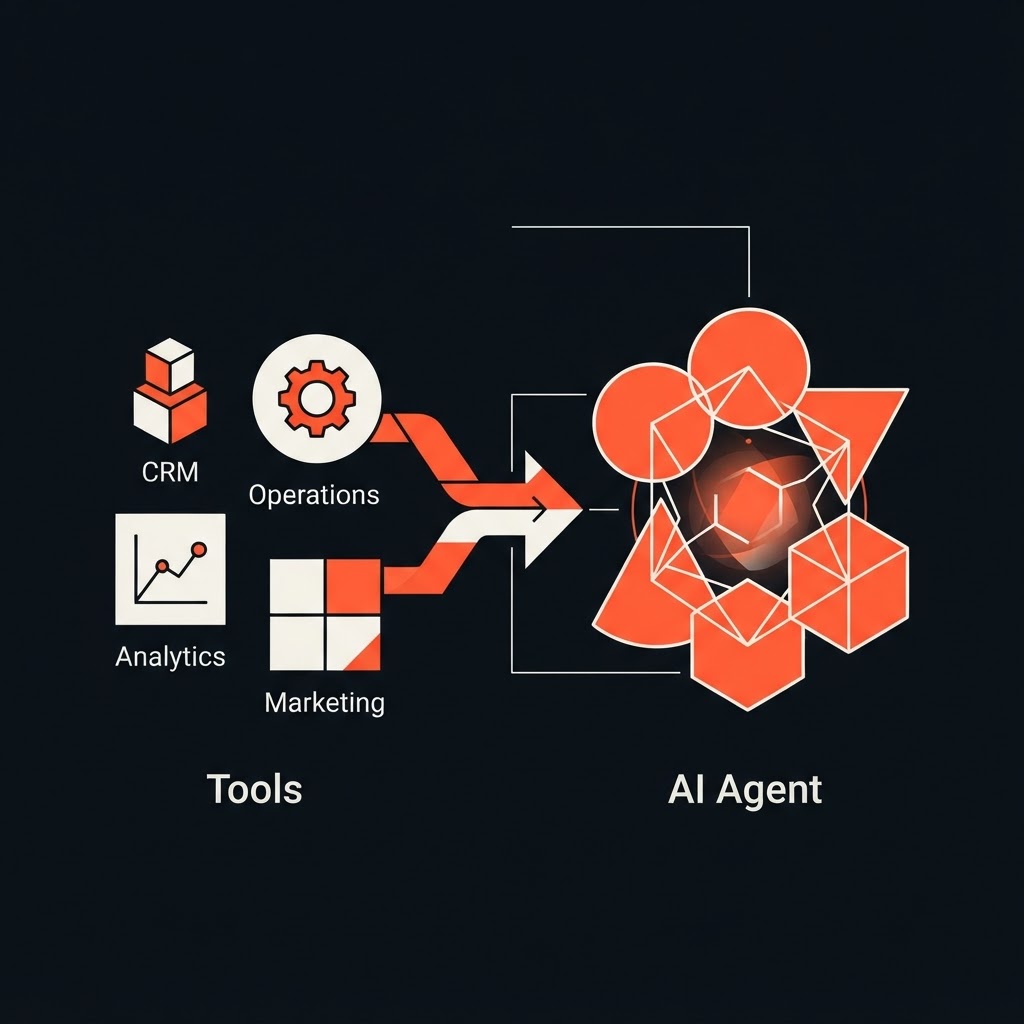
This shift matters because it addresses the number one bottleneck for small firms: time. A small team often struggles with the hand-offs between different pieces of software. Agents bridge these gaps by working across your CRM, accounting software, and email platform just like a human employee would.
Why Your Data is the Bottleneck
Recent discussions at the Black Hat security conference in Las Vegas highlighted a growing concern for businesses adopting these agents. As AI systems gain the power to take actions, they also gain the power to make mistakes. If an agent has access to your bank account or customer list but lacks the proper context, it can create significant operational risks.
This is where the concept of an AI second brain becomes essential. An agent is like a talented intern. It has the skills to do the work, but it does not know your specific business rules, your tone of voice, or your historical client relationships. Without a central knowledge base to guide it, an agent is a liability.
An AI second brain acts as the internal library for your company. It stores your standard operating procedures, your past project data, and your communication preferences. When you connect an autonomous agent to a second brain, you give it the context it needs to act accurately. The brain provides the instructions, and the agent provides the labor.
How an AI Second Brain Drives Speed
At Rapaport.ai, we see small businesses trying to skip the foundational step of organizing their data. They want the automation without the preparation. However, the news from this week proves that the businesses winning with AI are those that treat their data as a strategic asset.
When a small business has a well-structured AI second brain, they can deploy agents in hours rather than weeks. Instead of teaching an agent how to write a proposal every time, the agent simply looks at the second brain to see how the company has written successful proposals in the past. This makes the entire operation move faster because the AI is not guessing. It is following a proven internal playbook.
This infrastructure also solves the problem of employee turnover. When a key staff member leaves, their knowledge usually goes with them. If that knowledge is captured in a second brain, the new employee or the AI agent can step in immediately without a drop in productivity.
Building for the Future of Work
The goal for the remainder of 2026 should be to move beyond experimentation. Small businesses that continue to use AI only for basic writing will fall behind competitors who are building agentic workflows.
Start by identifying one high-volume, repetitive process in your business. This might be customer onboarding, lead qualification, or monthly reporting. Instead of looking for a single tool to fix it, focus on how you can document that process so an AI can understand it. By building an AI second brain today, you are creating the foundation for the autonomous agents of tomorrow. The technology to automate your business is here. Your job is to give it the brain it needs to work for you.
Rather have this built for you? That's what we do.
Leave a Comment
Comments (0)
Related Articles

Autonomous AI agents are moving beyond simple chatbots to handle complex, multi-step tasks without human intervention. For small business owners, this shift represents a major opportunity to reclaim time and scale operations effectively.
Small businesses are shifting from simple AI tools to autonomous agents that manage entire workflows. Discover how an AI second brain provides the context these agents need to succeed.
Small business owners are increasingly turning to AI to reclaim time and drive growth. Building an AI second brain is the next step to turning scattered information into a competitive advantage.